


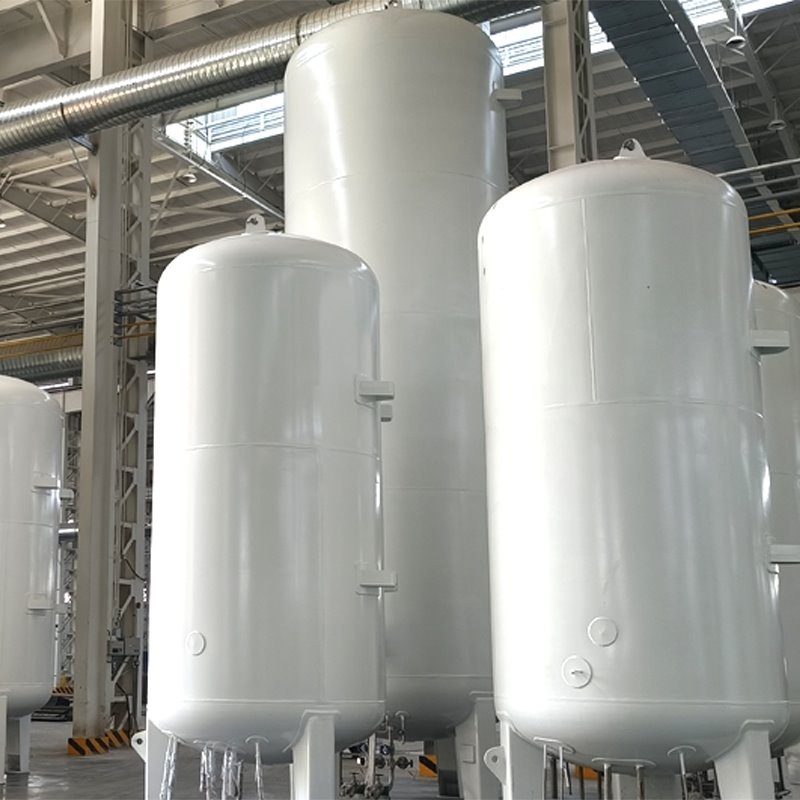
Vacuum Insulated LCO₂ Storage Tank
Introduction
The vacuum-insulated LCO₂ storage tank is a core piece of equipment for cryogenic liquid storage, utilizing either "high-vacuum multilayer insulation" or "vacuum powder insulation" technology. By creating and maintaining a high-vacuum environment between the inner and outer tanks, it effectively blocks heat transfer, enabling extremely low loss and long-term stable storage of liquid carbon dioxide (-20°C).
Main advantages and functions
Core function
1. Efficient cooling and reduced evaporation losses
A high vacuum environment is formed between the inner and outer shells of the storage tank, and insulation materials such as pearl sand are filled to significantly suppress heat conduction, convection, and radiation. This results in an extremely low evaporation rate of liquid carbon dioxide, which can remain liquid even after long-term storage, significantly reducing material loss and operating costs caused by vaporization
2. Safely store high-pressure and low-temperature media
Liquid carbon dioxide is stored at low temperatures, but there is still a certain saturation vapor pressure inside the container (usually working pressure is 2.16MPa to 2.5MPa). The vacuum insulation structure combined with high-strength low-temperature steel (such as 16MnDR inner liner and Q345R outer shell) ensures the structural strength and safety of the container under extreme temperature and pressure differences, preventing dangerous situations caused by sudden pressure increases due to temperature rise
3. Realize centralized and stable gas supply
As a large-scale storage unit, vacuum insulated CO₂ storage tanks can serve as a "transfer station" for industrial gas sources, converting liquid CO₂ into gas through vaporizers, providing downstream users with stable and high flow gas supply, avoiding the trouble of frequent replacement of steel cylinders.
Selection and usage precautions
1. Work pressure: It is usually divided into two types: 0.8MPa (low pressure) and 1.6MPa (medium pressure), which need to be matched according to storage capacity and usage scenarios.
2. Capacity specifications: Common capacities range from 0.5m ³ to 50m ³, and large storage tanks require a professional liquid level monitoring system.
3. Safety certification: A pressure vessel manufacturing license (such as A3 level) is required
4. In daily use, frequent opening of the lid for liquid extraction should be avoided to prevent rapid vaporization of liquid carbon dioxide and abnormal pressure in the storage tank; At the same time, anti freezing measures should be taken to prevent the valve from being affected by low-temperature freezing during operation.
Parameter Specifications
|
Nominal volume |
design pressure |
Insulation form |
Daily evaporation rate |
Material of inner/outer tank |
|
20 m³ – 500 m³ |
Low pressure type: 0.8-1.6 MPa (G) Medium pressure type: 1.6-2.2 MPa (G) |
High vacuum multi-layer insulation |
≤ 0.1% -0.2%/day |
Inner liner: S30408/S31603 stainless steel; Shell: Carbon steel. |
(For Reference Only)
The economic benefits that can be brought by CO₂ recovery equipment
- Direct loss savings
- Ensure flexibility in production and sales
- Reduce long-term operating and maintenance costs
- Enhance the overall image and reliability of the project
Main components
Tank body
◇ Inner liner: A stainless steel pressure vessel that accommodates LCO₂.
◇ Shell: A carbon steel container that protects the vacuum interlayer and withstands external pressure.
01
Insulation system (core)
◇ High vacuum interlayer: Extract high vacuum (usually ≤ 0.1Pa) between the inner and outer tanks.
◇ Insulation material: filled with pearl sand or wrapped with multiple layers of aluminum foil composite insulation material
02
Pipeline and support system
◇ Insulated pipeline: The pipelines connecting the inner and outer tanks are both vacuum insulated or have a long neck structure to prevent "cold bridges".
◇ Suspension/support system: The inner liner is supported by a low thermal conductivity material (such as fiberglass) in the outer shell to reduce heat conduction.
03
Instrumentation and Safety Systems
◇ Vacuum gauge: Real time monitoring of interlayer vacuum degree.
◇ Explosion proof device: The inner tank is equipped with safety valves and rupture discs; Explosion proof device for interlayer.
◇ Leakage monitoring device: Monitor whether the interlayer is leaking.
04
Voltage regulation and operation system
◇ Self booster/evaporator: uses a small amount of evaporated gas to maintain stable pressure inside the tank.
◇ Infusion valve/exhaust valve
05
◇
Hot Tags: vacuum insulated lco₂ storage tank, China vacuum insulated lco₂ storage tank manufacturers, suppliers, factory, Food grade CO Liquefaction Equipment, Polyurethane Foam Insulated LCO Storage Tank, CO Cylinder Filling Unit, Vacuum Insulated LCO Storage Tank, liquefaction storage equipment
You Might Also Like


Send Inquiry